7.1 Dependency Management & Build Strategy
To optimize image sizes, improve load times, and isolate dependencies, the architecture utilizes a multi-stage Dockerfile and modularized requirement files.
Dependency Split
Dependencies are split by runtime responsibility. This ensures that the web application stays slim (avoiding heavy pandas, geopandas binaries, etc) and the scheduler avoids unnecessary web-routing libraries.
Documentation-only tooling is kept outside the container requirement split. For example, the printable ER diagram generator uses its own documentation/print_er_diagram/requirements.txt so eralchemy2 and pygraphviz are installed only when regenerating that artifact.
Dependency Overlap Matrix
The following matrix visualizes the specific libraries included in each build stage. Note how base is inherited by all stages, and test aggregates everything to ensure a complete integration environment.
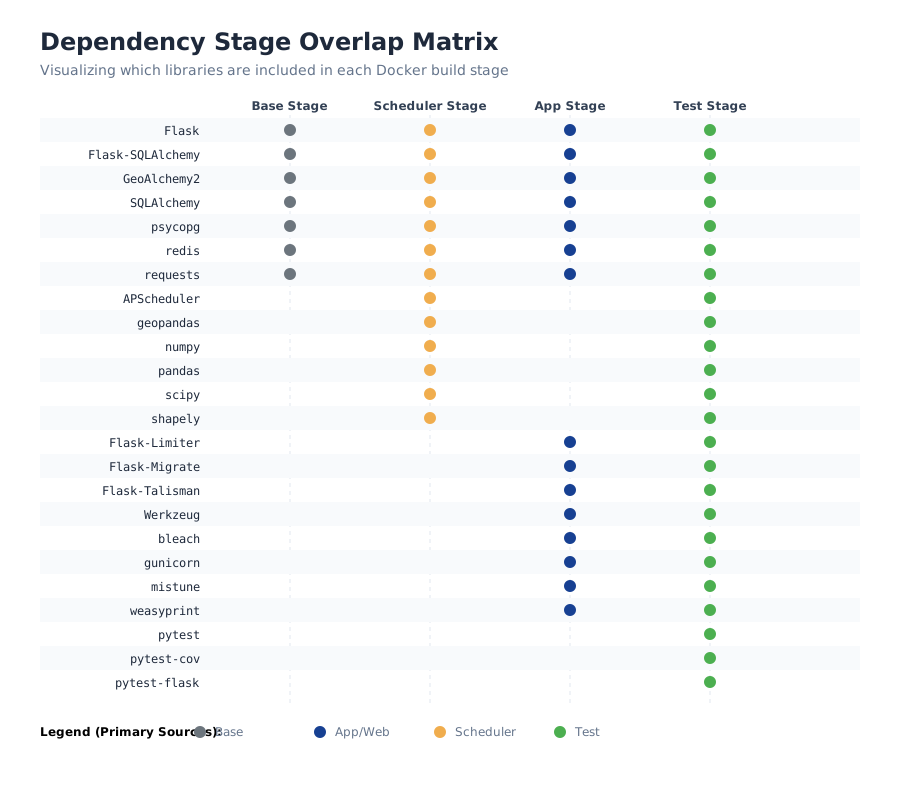
Generated via documentation/scripts/generate_dependency_overlap.py
requirements-base.txt: Shared core backend foundations requested by all containers (Flask-SQLAlchemy>=3.1.1,<4.0,Flask>=3.1.3,<4.0,GeoAlchemy2>=0.19.0,<1.0,psycopg[binary]>=3.3.3,<4.0,redis>=7.4.0,<8.0,requests>=2.33.1,<3.0,SQLAlchemy>=2.0.49,<3.0).requirements-web.txt: Web-only stack for the API and UI (bleach>=6.3.0,<7.0,Flask-Limiter>=4.1.1,<5.0,Flask-Migrate>=4.1.0,<5.0,gunicorn>=25.3.0,<26.0,mistune>=3.2.0,<4.0,weasyprint>=68.1,<69.0,Werkzeug>=3.1.8,<4.0).requirements-scheduler.txt: Heavy geospatial stack required for the data pipeline (APScheduler>=3.11.2,<4.0,geopandas>=1.1.3,<2.0,numpy>=2.4.4,<3.0,pandas>=3.0.2,<4.0,scipy>=1.17.1,<2.0,shapely>=2.1.2,<3.0).requirements-test.txt: Testing frameworks (pytest-cov>=7.1.0,<8.0,pytest-flask>=1.3.0,<2.0,pytest>=9.0.3,<10.0).
Dockerfile Stages
The Dockerfile resolves four distinct logical build targets:
baseStage- Establishes normal Python environment.
- Installs
requirements-base.txt.
app-stageStage- Used by the
appservice. - Installs UI/PDF system level libraries (Cairo/Pango).
- Installs
requirements-web.txt.
- Used by the
scheduler-stageStage- Used by the
schedulerservice. - Installs heavy C++ geospatial system libraries (GDAL/GEOS/PROJ).
- Installs
requirements-scheduler.txt.
- Used by the
test-stageStage- Used by the
testservice. - Starts from
app-stage, but forcibly adds the scheduler geospatial libraries. - Installs both
requirements-scheduler.txtandrequirements-test.txt. - This merged image allows integration tests to test both web routes and pipeline functions simultaneously.
- Used by the
Automated safeguards for doc drift: GitHub Actions automatically updates the matrix and lists on every push. Additionally, tests/test_dependency_docs_sync.py validates that dependency lists in this document remain synchronized with all requirements-*.txt files.