Matching Process
The matching pipeline correlates ATLAS boarding platforms with OSM public transport nodes. It is ATLAS-driven and sequential: predicates run in a fixed priority order, and every successful commit() immediately locks the matched ATLAS and OSM representatives so later logic only sees what is still free.
This page is organized in the same order the code runs:
- Load raw data into state managers
- Pre-group duplicates and obvious OSM pair/trio groups
- Run the 10 predicate executions in order
- Record matches through
ctx.commit() - Return
PipelineResult/MatchingOutput
End-to-End Flow
Conceptual Abstractions
The runtime flow above shows execution order. The diagram below shows the conceptual layers the code is built around: predicates decide, the context orchestrates, the state layer answers queries and tracks locks, and domain models flow upward as the shared data abstraction.
What Counts as a Match
A match is represented by a MatchRecord, which links one AtlasNode to one OsmNode plus metadata about how the link was made.
| Field | Description |
|---|---|
atlas_node |
The matched ATLAS platform |
osm_node |
The matched OSM node |
match_type |
Which rule produced the link, for example exact, name, distance_matching_3b |
distance_m |
Haversine distance stored by the predicate |
notes |
Short explanation such as gtfs_tokens or Exact local_ref match within max_distance |
problems |
Quality flags populated later by problem evaluation |
Most links are 1 ATLAS → 1 OSM, but the pipeline intentionally allows these exceptions:
| Cardinality | Why it happens | Where it comes from |
|---|---|---|
| N ATLAS → 1 OSM | One OSM node is the only candidate for a UIC | ExactUicPredicate single-OSM case |
| 1 ATLAS → N OSM | One ATLAS entry is matched to multiple OSM nodes sharing the same UIC | ExactUicPredicate single-ATLAS case |
| N ATLAS → 1 OSM | Duplicate ATLAS siblings are auto-expanded after the representative matches | ctx.commit() |
| 1 ATLAS → N OSM | OSM pair siblings are auto-expanded after the representative matches | ctx.commit() for pair groups only |
For osm_trio, the pipeline still creates only the two primary side-node MatchRecords. The middle stop_position is not a MatchRecord; it becomes an effectively_matched database row later during import when both trio sides were matched.
Phase 1: Build State Before Matching
The matcher does not work directly on raw DataFrame rows or raw XML tags. It first builds two state managers.
| State | Built from | Main job |
|---|---|---|
AtlasState |
stops_ATLAS.csv |
Convert ATLAS rows into AtlasNodes, track matched SLOIDs, load route evidence |
OsmState |
osm_data.xml |
Parse OSM nodes, selected way-based stops, and route relations; build attribute indexes; build spatial index on demand |
AtlasState
AtlasState.from_dataframe() does three important things before the first predicate runs:
- Converts ATLAS rows into immutable
AtlasNodemodels on demand. - Detects duplicate groups where entries share the same
number+designation. - Loads
data/processed/atlas_line_families.csv,atlas_itineraries.csv, andatlas_itinerary_stop_calls.csvintoget_route_evidence(sloid)so route matching can stay file-I/O free.
ATLAS duplicate grouping
ATLAS duplicates are grouped before matching, with no distance heuristic.
duplicate_sloid_mapgroups rows sharing the same(number, designation).- The first sorted SLOID becomes the representative.
- The remaining SLOIDs become hidden siblings.
get_unmatched_records()returns oneAtlasEntitywrapper for the representative instead of exposing all siblings individually.
When that representative is committed, siblings get their own MatchRecords with match_type='duplicate_propagation'.
OsmState
OsmState.from_xml_file() parses OSM nodes, selected way-based stops, and route relations into several indexes over the same underlying node set.
| Index / Store | Purpose | Used by |
|---|---|---|
_uic_ref_dict |
Lookup by uic_ref |
Exact matching and OSM grouping |
_name_index |
Lookup by name, uic_name, gtfs:name |
Name matching |
_node_routes |
Per-node GTFS route memberships from route relations | Route matching |
name_dirs / uic_dirs |
Per-node direction strings | Route matching |
| Lazy KDTree | Radius queries in metres | Distance and route matching |
OsmNode.is_station returns True for public_transport=station or railway=station, but explicitly not for public_transport=stop_position and not for aerialway=station.
OSM grouping before predicates
OsmState.build_groups() runs before matching so obvious OSM siblings behave like one logical entity during predicate execution.
Grouping now runs in two layers, in this order:
- Trios first (
osm_trio) for strict 3-node UIC cases. - Pairs second for all remaining reciprocal sibling pairs, with a perfect-count branch first.
The map uses one consistent visual convention for grouped OSM structures:
- Solid blue lines are ATLAS-OSM matches.
- Dashed green lines are OSM-OSM structural links inside a pair or trio.
- Trio middles are shown on the map once imported as
effectively_matched, but they are still not pipelineMatchRecords.
| Group type | Representative | Sibling(s) | Core rule |
|---|---|---|---|
osm_trio |
One non-middle side node | Side partner + identified middle | UIC-scoped trio: exactly 3 OSM nodes + exactly 1 stop_position + exactly 2 ATLAS rows for that UIC, with both side nodes within 15 m of the middle |
osm_pair_uic_equal_15m |
public_transport=platform |
public_transport=stop_position |
UIC-scoped perfect-count branch: platform_count == stop_position_count == atlas_effective_count; reciprocal nearest-neighbour within 15 m; no ratio gate |
osm_pair_uic |
public_transport=platform |
public_transport=stop_position |
Reciprocal nearest-neighbour pairing within 12 m, UIC-scoped |
osm_pair_name_equal_15m |
public_transport=platform |
public_transport=stop_position |
Name-scoped perfect-count branch (anchored to UIC): equal counts + reciprocal nearest-neighbour within 15 m; no ratio gate |
osm_pair_name |
public_transport=platform |
public_transport=stop_position |
Same spatial pairing, but name-scoped and anchored back to a UIC |
osm_pair_tram_equal_15m |
railway=tram_stop |
public_transport=stop_position |
Tram-scoped perfect-count branch: equal counts + reciprocal nearest-neighbour within 15 m; no ratio gate |
osm_pair_tram |
railway=tram_stop |
public_transport=stop_position |
Same pairing logic for tram stops |
Visual examples
The screenshots below are represented as simplified SVG schematics so the pair/trio semantics remain readable in the documentation PDF as well.
OSM trio matched to 2 ATLAS stops
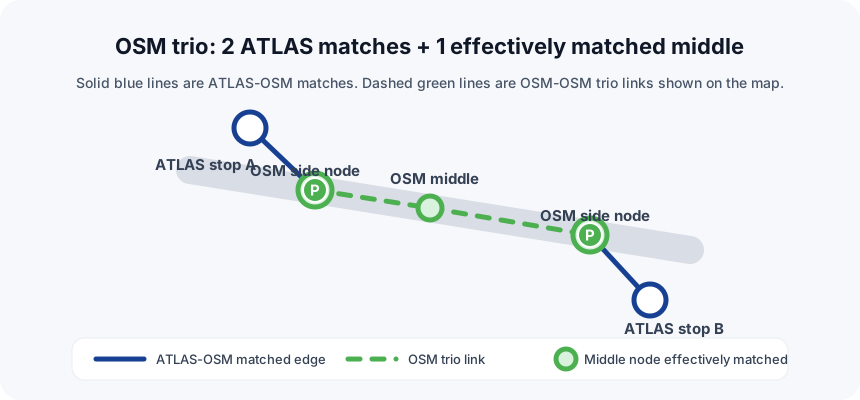
The trio's two side nodes are the only true pipeline matches. The middle stop_position remains unmatched during predicate execution, then becomes effectively_matched during import so it can be rendered on the map with dashed green OSM-OSM links to both sides.
OSM pair matched to 1 ATLAS stop
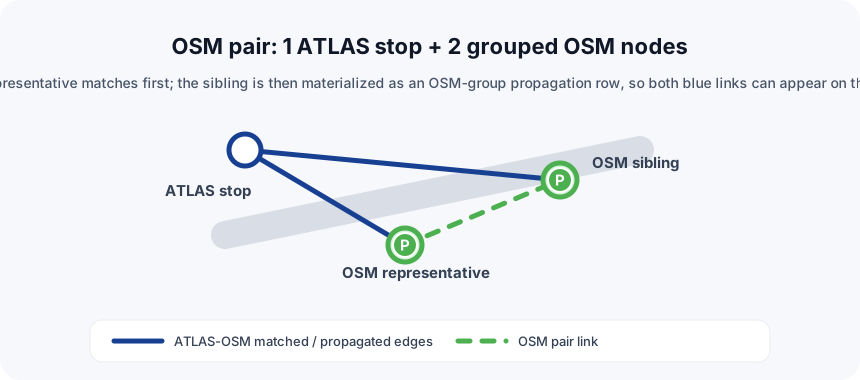
For a pair, the representative node matches first and ctx.commit() propagates that result to the sibling as osm_group_propagation. On the map this reads as two blue ATLAS-OSM links plus one dashed green OSM-OSM pair link.
Important details:
- Grouping uses reciprocal nearest-neighbour checks, not just raw proximity.
- Trios are only registered when both side nodes are within
15 mof the middlestop_position; otherwise those nodes stay available for the later pair grouping paths. - For perfect-count anchors (
left_count == right_count == atlas_effective_count), grouping first tries reciprocal conflict-free pairing within15 mand bypasses ratio checks. atlas_effective_countis computed per UIC by counting only ATLAS rows whose nearest same-UIC OSM node is within30 m.- The strict/relaxed fallback path still uses the original (unfiltered)
atlas_count. - If the perfect-count branch does not apply or cannot produce a full 1:1 pairing, it tries a
1.5ratio threshold and accepts those pairs only when grouped + ungrouped OSM entities exactly match the ATLAS count for that anchor. - If the strict complete-count check fails, it retries with
2.0and accepts reciprocal pairs it finds as an incomplete group set. - In ratio-based paths, the ratio test compares the nearest candidate (which must be within
12 m) against the true second-nearest candidate, even if that second candidate is beyond12 m. If no second candidate exists at all, the ratio test does not reject the pair. - The same perfect-count-first then strict-vs-incomplete policy applies to UIC, name, and tram pairing paths.
After grouping, lookup methods such as get_by_uic(), get_by_name(), and batch_query_radius() return OsmEntity wrappers for representatives while hiding siblings.
Phase 2: Run the Predicate Pipeline
The runner executes predicates in this order:
Each predicate sees only the current unmatched view of the state. Once a representative is committed, later predicates skip it automatically.
| Execution | Predicate | Match types | What it actually does |
|---|---|---|---|
1 |
TrioDistanceMatchingPredicate |
distance_matching_trio |
Absolute first run. For each trio UIC with exactly 2 unmatched ATLAS rows, match the two non-middle side nodes via minimum-total-distance 2x2 assignment; keep middle node unmatched |
2 |
ExactUicPredicate |
exact |
Matches AtlasNode.uic_ref to OsmNode.uic_ref; when both sides have multiples, refines by designation == local_ref |
3 |
NameMatchPredicate |
name |
Matches designationOfficial through the OSM name index and optionally refines by designation == local_ref |
4 |
RouteMatchPredicate |
route_gtfs_tokens, route_gtfs_direction |
Still limited to 50 m, then commits only mutual unique-best route-supported edges: GTFS token overlap first and exact direction-name fallback second; equal-strength ambiguities are skipped |
5 |
GroupProximityPredicate |
distance_matching_1_uic_ref, distance_matching_1_uic_name, distance_matching_1_name |
Conflict-free maximum-cardinality assignment within grouped ATLAS and OSM candidates |
6 |
LongDistanceGroupProximityPredicate |
long_distance_group_proximity_uic_ref, long_distance_group_proximity_uic_name, long_distance_group_proximity_name |
Repeats the group-proximity logic with a wider 150 m cap to catch conflict-free grouped matches that the 50 m pass leaves behind |
7 |
LocalRefDistancePredicate |
distance_matching_2 |
Exact designation == local_ref within 50 m |
8 |
NearestDistancePredicate |
distance_matching_3a |
First single-candidate nearest-distance pass within 50 m |
9 |
NearestDistancePredicate |
distance_matching_3b |
Ratio-test nearest-distance pass within 50 m |
10 |
NearestDistancePredicate |
distance_matching_3a_second_pass |
Second single-candidate nearest-distance retry after ratio-pass locking |
Predicate contract
All predicates implement the same interface:
class BasePredicate(ABC):
    @abstractmethod
    def run(self, ctx: MatchingContext) -> None:
        ...
They do not return match records. They query state and call ctx.commit() when they decide to match.
Phase 3: Record Matches Through ctx.commit()
MatchingContext.commit() is the only mutation gateway in the pipeline.
For osm_trio groups, ctx.commit() intentionally skips OSM sibling propagation so the trio middle node does not become an osm_group_propagation match. During the database import phase, if both of its side nodes are successfully matched, the importer promotes the middle node directly to effectively_matched for fast querying and map rendering.
That immediate locking is why the pipeline is safe even inside a single predicate loop: later rows consult the updated state, not just the original snapshot.
This matters especially for the predicates that batch KDTree lookups up front:
LocalRefDistancePredicateNearestDistancePredicateRouteMatchPredicate
They all re-check used_ids against the live state before committing so they do not reuse a stale candidate computed earlier in the same run.
Phase 4: Global Matching Rules
Station filtering
| Predicate family | Stations excluded? | Notes |
|---|---|---|
| Exact and name matching | Yes, according to OsmNode.is_station |
get_by_uic() and get_by_name() exclude public_transport=station and railway=station; aerialway=station remains eligible because OsmNode.is_station explicitly returns False for aerialway stations |
| Group proximity, local-ref, nearest-distance, and route matching | Yes, according to OsmNode.is_station |
Grouped lookups and batch_query_radius(..., include_stations=False) apply the same filter |
| Trio distance matching | No additional station filter | It operates on the two side nodes of already registered UIC trios |
Spatial constants
| Constant | Value | Used by |
|---|---|---|
max_distance |
50 m |
Route matching, the first group-proximity pass, local-ref matching, and nearest-distance matching |
LONG_DISTANCE_GROUP_PROXIMITY_MAX_DISTANCE_M |
150 m |
Long-distance group-proximity pass |
RATIO_TEST_FACTOR |
4 |
NearestDistancePredicate |
RATIO_TEST_MIN_D2 |
10 m |
NearestDistancePredicate |
GROUP_MAX_DISTANCE_M |
12 m |
OSM pre-grouping |
GROUP_PERFECT_COUNT_MAX_DISTANCE_M |
15 m |
OSM pre-grouping perfect-count branch |
TRIO_MAX_MIDDLE_DISTANCE_M |
15 m |
OSM trio registration |
ATLAS_NEARBY_OSM_MAX_DISTANCE_M |
30 m |
Perfect-count ATLAS effective count |
Distance storage
All predicates store the actual haversine distance they used, including exact UIC matches.
Outputs
run_pipeline() returns a PipelineResult, and run_matching() wraps it into MatchingOutput.
| Type | Fields | Description |
|---|---|---|
PipelineResult |
matched, unmatched_atlas, unmatched_osm |
Pure pipeline output |
MatchingOutput |
PipelineResult fields plus duplicate_sloid_map, osm_stop_units, all_osm_nodes |
Pipeline output plus pre-pipeline grouping state needed by the importer |
unmatched_atlas contains all unmatched nodes, including hidden duplicate siblings of unmatched representatives. unmatched_osm contains all unmatched OSM nodes, including group siblings and stations if they were never used.
No-nearby-OSM detection
After matching, the importer separately flags unmatched ATLAS rows that have no OSM node at all within 50 m. That does not create additional matches; it feeds problem detection.
Domain Models
The pipeline uses three core domain models plus two entity wrappers.
| Type | Purpose |
|---|---|
AtlasNode |
Immutable ATLAS platform model |
OsmNode |
Immutable OSM node model |
MatchRecord |
Mutable link object with match metadata |
AtlasEntity |
Wrapper that exposes one representative plus duplicate siblings |
OsmEntity |
Wrapper that exposes one representative plus grouped OSM siblings |
Key fields on AtlasNode:
| Field | Source |
|---|---|
sloid |
sloid |
uic_ref |
number |
designation |
designation |
designation_official |
designationOfficial |
business_org_abbr |
servicePointBusinessOrganisationAbbreviationEn |
Key fields on OsmNode:
| Field | Source |
|---|---|
node_id |
XML node id |
local_ref |
local_ref, falling back to ref |
name |
name |
uic_name |
uic_name |
uic_ref |
uic_ref |
network, operator |
Same-named OSM tags |
public_transport, railway, amenity, aerialway |
Same-named OSM tags |
tags |
Full tag dict |
Performance Notes
Spatial matching uses a lazy scipy.spatial.cKDTree over 3D unit-sphere coordinates. The tree is cached and only rebuilt when the station-inclusion mode changes; matched nodes are filtered at query time rather than by rebuilding the tree after every commit.
The batched KDTree path is used by the local-ref, nearest-distance, and route predicates. GroupProximityPredicate does not use the KDTree; it builds a full pairwise distance matrix with NumPy broadcasting over each grouped candidate set.
Results Summary
| Metric | Value |
|---|---|
| ATLAS platforms | 55,063 |
| Matched pairs | 63,862 |
| Match rate | 89.5% |
| Unmatched ATLAS | 5,769 |
| Unmatched OSM | 7,862 |
Code References
| Component | File |
|---|---|
| Domain models | models.py |
| Orchestrator | orchestrator.py |
| Pipeline framework | pipeline.py |
| State management | state.py |
| Exact matching | predicates/exact_matching.py |
| Name matching | predicates/name_matching.py |
| Distance matching | predicates/distance_matching.py |
| Route matching | predicates/route_matching_gtfs.py |
| Spatial index | utils/spatial_index.py |