0.4 Glossary
The words this site and its user guide use. Terms of the code, the engine and the deployment are in the developer glossary.
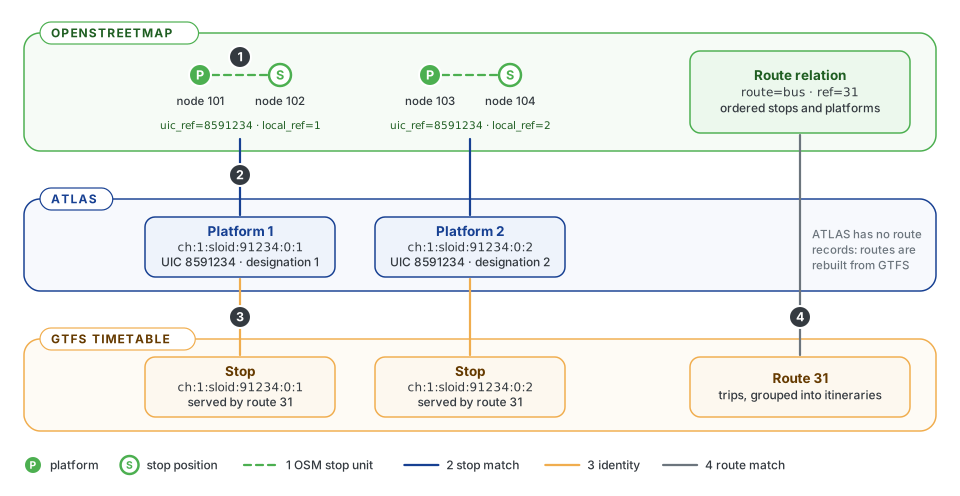
The figure shows most terms of the first two groups on one illustrative stop.
Datasets and identifiers
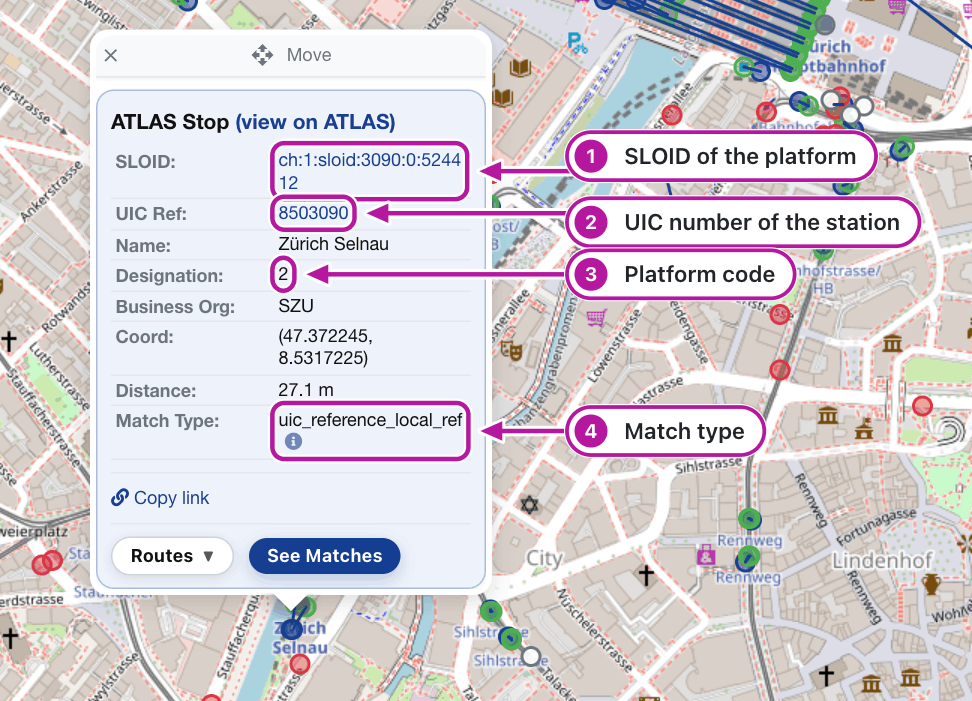
Look at the numbers in the picture, the popup of one ATLAS platform on the map:
- The SLOID of the platform.
- The UIC number of its station.
- The platform code, called Designation in ATLAS.
- The match type: the rule that linked the platform to its OSM element.
ATLAS
Switzerland's official registry of public transport locations, maintained for the Federal Office of Transport and published on opentransportdata.swiss. The project uses its platforms: one record per platform. See E1.1 ATLAS stops.
Service point
A stop or station as a whole in ATLAS, for example Zürich HB. It has a UIC number and a SLOID such as ch:1:sloid:3000. Its platforms are the records the project matches.
SLOID
The Swiss location identifier of an ATLAS service point or platform: ch:1:sloid:<number>:<area>:<platform>, where <number> is the UIC number without the country prefix 85 and without leading zeros. Example: platform 33 of Zürich HB is ch:1:sloid:3000:501:33. The area part can be empty (ch:1:sloid:75014::80). Mappers can tag it on the platform's OSM elements as ref:sloid (or railway:ref:sloid); matching then links them by it first (identifier rule).
UIC number
The seven-digit station number shared by all platforms of one service point. Swiss numbers start with 85, for example 8503000. It appears as number in ATLAS and as the uic_ref tag in OpenStreetMap, and matching uses it to find the OSM elements of the same station.
Platform code
The label of a single platform: designation in ATLAS, platform_code in GTFS and local_ref in OpenStreetMap. Several rules use it to choose between platforms of the same station.
GTFS
The General Transit Feed Specification, the standard timetable format. A feed is a set of CSV files: stops.txt, routes.txt, trips.txt and stop_times.txt matter here. The Swiss feed comes from opentransportdata.swiss; other agencies' feeds can be matched too. See E1.2 GTFS and ATLAS.
stop_id
A GTFS stop identifier. In the Swiss feed, most platform stop_ids are the platform's SLOID; the engine resolves every stop_id to a SLOID, including those that do not follow this convention (E1.2).
OpenStreetMap modelling
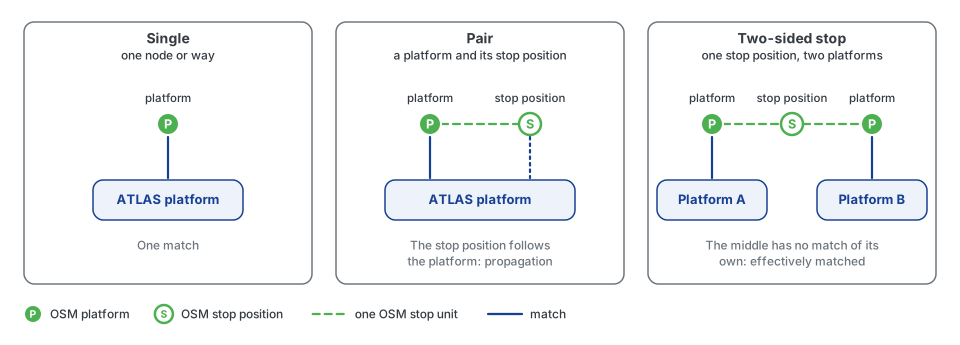
The figure shows the three kinds of OSM stop unit and how each is matched; propagation and effectively matched are explained under Matching.
OSM element
An OpenStreetMap object that can represent a stop: a node, or a way represented by its centre. Elements are selected by tags such as public_transport=platform, highway=bus_stop or railway=tram_stop; see E1.3 OSM data.
Platform and stop position
The OpenStreetMap public transport scheme (PTv2) maps a stop twice: a public_transport=platform element where passengers wait, and a public_transport=stop_position node on the road or track where the vehicle stops. One ATLAS platform therefore often corresponds to two OSM nodes.
OSM stop unit
One logical OpenStreetMap stop, built before matching: a single element, a pair (a platform with its stop position) or a two-sided stop (one stop position with a platform on each side of the road). Matching treats the unit as one stop, and the statistics count units, not nodes. See OSM grouping.
Disused OSM element
An OSM element whose stop tag carries a lifecycle prefix, such as disused:highway=bus_stop; the prefixes are disused:, abandoned:, removed:, demolished:, razed:, destroyed: and was:. It is never matched and never counted as a stop. It gets a disused problem only when it still needs attention, and the map shows it when OSM disused is selected in the Unmatched filter. See E1.3 OSM data.
Route relation
An OpenStreetMap relation tagged type=route: one direction or variant of a line, with its stops and platforms as ordered members. A type=route_master relation groups the route relations of one line.
Matching
Match
A link between one ATLAS platform and one OSM element. A platform can have several matches (for example both nodes of a pair), and some rules let several platforms share one OSM element.
Matching rule
One way of deciding a match: by a shared identifier (identifier rule), as a two-sided stop, by station number and platform code, by name, by the GTFS routes that serve both stops, or by distance. The rules run in a fixed order, and each rule only sees stops that are still unmatched. See E2 Matching process.
Match type
The rule and branch that created a match, named after the evidence it used: for example sloid_identifier (the OSM element's ref:sloid names the platform), uic_reference_local_ref (same UIC number, platform code equal to local_ref), gtfs_shared_route or distance_only_candidate. See the matching rules. Matches created by propagation have the type source_duplicate_propagation or osm_pair_propagation.
Identifier rule
The first matching rule. An OSM element tagged ref:sloid (or railway:ref:sloid) with the SLOID of an ATLAS platform within 150 m is linked to that platform before any other rule runs. A value that names a far or unknown platform, or is not a SLOID, becomes an identifier problem. See E2.1.
Propagation
When a rule matches one member of a group, the other members follow: the other platforms of a duplicate group receive source_duplicate_propagation matches, and the partner of an OSM pair receives an osm_pair_propagation match. The middle of a two-sided stop is never propagated to.
Duplicate group
ATLAS platforms that share the same UIC number and platform code. One of them stands for the group during matching, and the others receive its matches by propagation.
Effectively matched
The state of a two-sided stop's middle stop position when both of its sides are matched. It has no match of its own; the map shows it linked to both sides.
Isolated
A stop with no element of the other dataset within 50 m. The map's "No OSM < 50m" filter shows isolated ATLAS platforms.
Routes
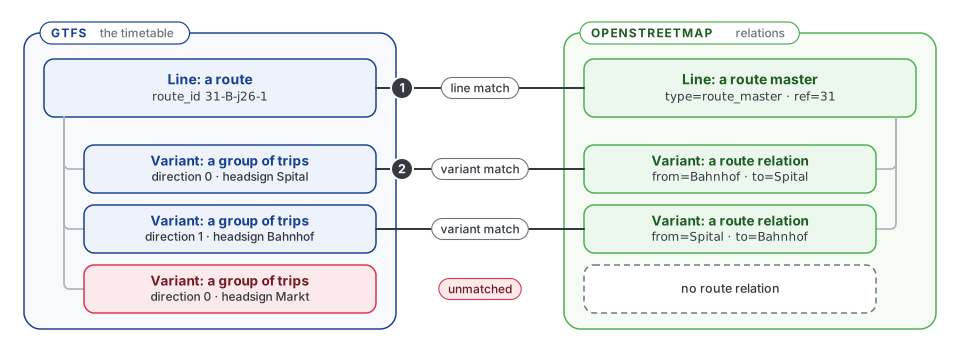
The figure shows a line with its variants on both sides: the lines are matched first (1), then their variants (2). Comparing routes explains it.
Line family
One public transport line: a GTFS route_id on the GTFS side, and on the OSM side a group of route relations, such as the members of a route master (how they are grouped). A line family can be matched to several families of the other side. See E3 Routes.
Itinerary
One direction or variant of a line family: the GTFS trips of one direction with the same headsign (the destination shown on the vehicle), or one OSM route relation. The Routes pages call it a variant.
Stop call
One stop of an itinerary, in order.
Problems
Problem
A detected data-quality issue, of type distance, unmatched, attributes, duplicates, contradicts_route_matching, disused (disused OSM element) or identifier (identifier rule), with priority P1 (critical), P2 (significant) or P3 (minor). See E4 Problems.
Using the site
Snapshot
The results the site shows, from one run of the matching. A new snapshot replaces the previous one all at once when its import is complete, so a page never mixes two runs.
Permalink
A URL that opens a page as it was when the link was copied: the map view, the open stop popup, the Problems page's entry and filters, or an open route variant. Each page keeps it in the address bar. See 0.3 Sharing links and the API.
Public API
The part of the JSON API that scripts and AI agents may rely on: /api/lookup, which returns every match of a stop named by a permalink identifier. The other /api/ endpoints serve the web pages and change without notice. See 0.3 Sharing links and the API.